Why Major Event Strategy Is Different From Company Strategy
The 10-Step Strategy Roadmap I used for the FIS Nordic World Ski Championships 2029 and IMGA Winter World Masters Games 2028
![Jesse Kiuru [Eventpreneur]'s avatar](https://substackcdn.com/image/fetch/$s_!iQ_5!,w_108,h_108,c_fill,f_webp,q_auto:good,fl_progressive:steep/https%3A%2F%2Fsubstack-post-media.s3.amazonaws.com%2Fpublic%2Fimages%2F0b99bf43-a7a9-4968-8aec-f2614b27b593_300x300.jpeg)
Most of us learned strategy from company life and business books in the same way.
You can almost see the deck before it exists: vision, mission, objectives, values, KPIs. It’s clean. It’s logical approach. And in companies, it often works.
But major events aren’t companies.
I’ve seen that again in two recent major event strategy projects of mine: the Winter World Masters Games 2028 and the FIS Nordic World Ski Championships 2029 in Finland.
When you copy-paste a general “company strategy template” into a major event, something predictable happens. The strategy sounds right, gets approved, and then quietly stops steering.
Over the years, I’ve seen this in too many organising committees. Not because people are careless. Because event planning has practical issues to deal and deadlines attached… and strategy often doesn’t.
At that point, the only question that matters is:
Is this strategy built to be read… or built to be run?
In most cases, company strategy gives direction to a system that already exists.
Major event strategy must run a temporary machine that has one live moment.
That difference changes everything.
Let me explain.
Company strategy assumes the machine is already running….
A company is a continuing system. Operations exist. Teams exist. Governance exists. Culture exists. Even when things are messy, the machine is real.
So strategy can stay at the level of direction and focus: what to prioritise, where to invest, what to stop, and how to measure progress over time.
If something doesn’t work, you adjust. You learn. You iterate. You recover next quarter.
…while major event strategy is a delivery system for a machine you’re still building
A major event is a different animal.
It’s a one-off machine built under a fixed deadline, with shared ownership and public judgement.
You don’t get to iterate in public.
You don’t get to “ship and improve later.”
You get one live moment.
And the machine that produces that moment is built while the clock is running.
That’s why major event strategy has to be more structured than company strategy.
Not because events are more important, but because the operating conditions are harsher.
Why events need their own strategy format
Major event strategy is different from company strategy because the system is different.
Here are my 8 key insights of the differences.
1) One shot vs. continuous iteration
A company can improve over quarters and years.
A major event has one live moment. No re-run possibility.
So strategy must become executable early.
2) Temporary machine vs. permanent organisation
Companies have stable teams, roles, processes, and culture.
Major events build a temporary organisation that changes constantly. People join mid-stream. Roles shift. Capacity is uneven. Knowledge is fragmented.
So the strategy must be simple enough to run, not just smart enough to approve.
3) Shared ownership vs. single authority
A company usually has one leadership chain and one balance sheet.
A major event often has a rights holder, host city, organiser, federations, venues, and other partners. Each has a different definition of success.
So event strategy must align outcomes and trade-offs across owners.
4) Planning will replace strategy unless strategy plugs into planning
Companies already have operations, suppliers, systems, and channels.
Events build everything while the clock is running: procurement, permits, staffing, governance, overlays, flows, safety, service — you name it.
So the strategy must plug into planning, or planning will replace it.
5) Trade-offs are constant, not occasional
Company strategy can live at a high level and let departments optimise.
In major events, every week is a decision: cut, keep, shift, simplify.
So event strategy must produce decision filters, not slogans.
6) Success is an experience, not just a result
Companies can measure performance over months, quarters and years.
Events are judged in moments: arrival, queues, competition flow, service, safety, atmosphere, departure.
So strategy must define what “quality” means in lived experience and operating standards.
7) Risk profile is front-loaded and unforgiving
Companies spread risk over time and portfolios.
Major events concentrate risk into a short window where failure is public.
So strategy must include more clearly “what must not fail” and how it’s protected.
8) Strategy must become a delivery structure
A company can treat strategy as direction and let teams build plans.
A major event strategy must become programs, projects, sub-projects, tasks via milestones, KPIs, and owners.
If it doesn’t show up on leadership desks as weekly priorities, it’s not steering.
To wrap those eight points:
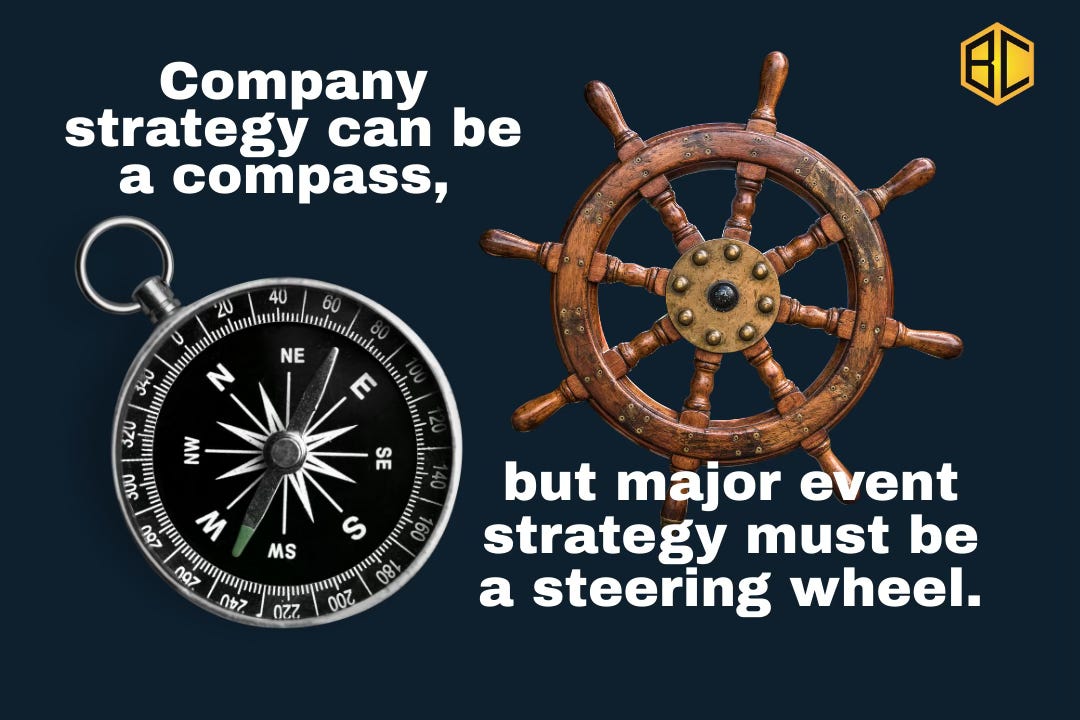
Company strategy can be a compass, but… major event strategy must be a steering wheel.
What this looks like in practice
In my latest work — Winter World Masters Games 2028 and the Nordic World Ski Championships 2029 — the deliverable wasn’t a deck that “sounds right.” The deliverable was a strategy roadmap that survives first contact with real life planning.
The output wasn’t a few summary slides for boards and organising committees. It was a 50+ page roadmap that translates the north star vision into practical guidelines for leadership and management.
The outcome should show up for my client as logic, clarity, and consistency in leading their great event projects. The world’s biggest multi-sport winter sports masters event in winter 2028. And the biggest winter festival in Finland in the decade.
A great major event strategy looks like a chain
As its best, a major event strategy is a set of choices made step by step, where each step produces an output the next step can use.
That’s how strategy becomes work, not wallpaper.
And that’s exactly the idea behind my 10-Step Strategy Roadmap for Major Events.
It flows like this:
Step 1. Vision → Where we’re going?
The future we want to create. Not what we do, but what changes in people’s lives, the city, and the culture if we do it right.
Step 2. Mission → What drives us forward every day?
What we do every day to move toward that future. A clear, repeatable line the whole team can stand for.
Step 3. Strategic Objectives → What we need to achieve to reach the vision?
The outcomes that make the vision real. Not tasks or projects — system-level key outcomes that move the event forward (into direction of the vision).
Step 4. Values → How we behave while doing the work?
Not slogans or vague adjectives. But, practical principles that keep people aligned when there’s no manual to check and pressure is high.
Step 5. Critical Success Factors (CSFs) → What must go right for each objective?
The few essential conditions that must hold for each objective to happen. This is where strategy start to connect to planning, operations and every day decisions.
Step 6. Key Performance Indicators (KPIs) → How do we know we’re succeeding?
The scoreboard for the CSFs. Measures that tell us if the essential things are actually happening.
Step 7. Zero Point → Where are we starting from?
The baseline. Starting point. Facts, not guesses — so progress is real, measurable, and honest.
Step 8. Program & Project Framework → How do we turn strategy into action?
The bridge from intent to delivery: Discover the main programs of your major event. Then link every program, and eventually project, directly to the strategy.
Step 9. Business Model & Revenue Strategy → How does the event generate value and income?
The money making logic should be clear from the start : where revenue comes from and what makes it work (ticketing, upsell, sponsorship, public funding, services, licensing, etc.).
Step 10. Brand Platform (Brand Strategy) → How we’re seen, felt, and remembered?
The foundation of perception: what we represent, how we speak, what experiences we create, and what we want people to remember.
Examples to follow…
In the next posts on my Substack, I’ll go through each step, one at a time, and show what I produced and why it matters in real delivery.
To be honest, this isn’t rocket science. Any major event team can use this 10-step roadmap as a template and avoid paying five-figure sums for consultants.
Read more at my homepage: https://www.jessekiuru.com/major-event-strategy-roadmap
The hard part is almost always something else (than the structure). It’s understanding the strategic context. The fundamentals of the event, the motives of the main stakeholders, and the real customers — fans, participants, and the people who decide whether the event is worth it.
The teams who understand this are able to build the best strategies for daily organisation. From understanding the core of the event, it’s pretty much just logic from Step 1 to Step 10.
That’s exactly what we did with the “Nothing Stops Us” strategy for the Winter World Masters Games 2028 in Finland.
Stay tuned.